

Fernando de Noronha’s headline attractions are Baía do Sancho, Baía dos Porcos, the Atalaia natural pool, the Baía dos Golfinhos viewpoint and Praia do Leão. The archipelago is a UNESCO World Heritage site, and visiting requires two separate mandatory payments — a state environmental tax charged per day of stay, and a national park ticket valid for ten days.
Noronha sits 545 kilometres off Recife and 360 off Natal, twenty-one islands and islets that are the exposed peaks of a submerged volcanic ridge. Only the main island is inhabited, by around 3,200 people. Roughly seventy per cent of it is a strict-protection national park, and essentially all of it sits inside a second, sustainable-use protected area on top of that.
It is the most regulated destination in Brazil, and that is exactly why it is still worth going. Almost everything below comes with a rule attached. Understanding the rules before you arrive is the difference between a good trip and a frustrating one.
1. What It Costs to Set Foot on the Island
Two charges, from two different governments, and paying one does not cover the other. This catches out more first-time visitors than anything else.
| Charge | Who levies it | 2026 rate | Notes |
| TPA — Taxa de Preservação Ambiental | State of Pernambuco | R$105.79 per day | Progressive, not a flat multiplication; same price for Brazilians and foreigners. Pay online in advance or at the airport counter — cards issued outside Brazil work only at the counter. |
| National park ticket | ICMBio (federal) | R$192 Brazilians / R$384 others | Valid 10 days. Set by Portaria ICMBio nº 4.423 of 14 October 2025, in force from 1 November 2025. |
Two warnings. First, ICMBio’s own page on gov.br still lists R$111 and R$222 — roughly half the real price — so if you fact-check against it you will budget wrong; the park’s ticketing site is the reliable source. Second, the last two price rises both took effect on 1 November, so if you are travelling late in the year, re-check before you pay.
The park ticket covers around seventy per cent of the archipelago, including thirteen beaches and the dive sites. Beaches inside the APA rather than the park — Conceição and Cacimba do Padre among them — are free.
The visitor caps
Pernambuco and the federal government agreed a cap of 11,000 visitors a month and 132,000 a year, ratified by Brazil’s Supreme Court. In 2025 actual arrivals reached about 139,900 — over the annual limit — and a 2026 carrying-capacity study concluded the island supports fewer people at once than are currently on it. Pernambuco has asked the aviation regulator to redistribute airport slots so that air capacity matches the cap.
For an individual traveller this changes nothing directly: there is no per-person booking quota and no system that can turn you away at the door. The cap is enforced upstream, through flight seats and licensed accommodation. What it does mean is that flights and beds are genuinely finite, and that Noronha is likely to get harder to book, not easier.
2. Baía do Sancho
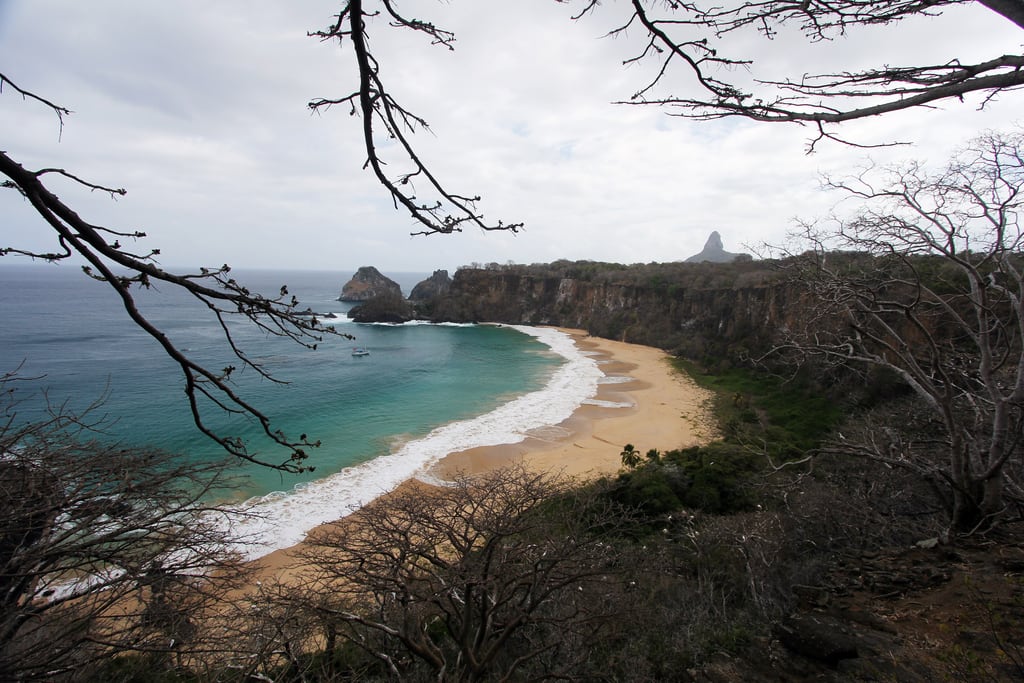
Sancho is the beach that made Noronha famous: a crescent of sand at the foot of a high cliff, reachable only by boat or by descending through a cleft in the rock. TripAdvisor’s Travelers' Choice awards named it the best beach in the world in 2014, 2015, 2017, 2019 and 2023.
You will see it claimed that Sancho won again in 2024 and 2025. It did not — TripAdvisor’s own announcements for those years, and for 2026, put the top spot in Portugal, Greece and Mexico respectively, with Sancho absent from the published top ten. It remains one of the great beaches on earth; it is simply not the current title-holder.
The famous ladder
The descent to the sand runs through a fissure in the cliff on a near-vertical escada de marinheiro — a ship’s ladder. The passage is narrow enough that bulky bags cannot come through with you. Because two people cannot pass, the park runs a published one-way timetable: the beach is open 08:00 to 18:00, with the ladder alternating between descent-only and ascent-only in roughly fifty-minute blocks, and both directions permitted only at the start and end of the day. Mornings queue more than afternoons.
Accessibility: The beach itself is not accessible — the descent is a vertical ladder. But the clifftop viewpoints above it are: a suspended walkway made from recycled material runs to them and is wheelchair accessible. That view, looking down into the bay, is the photograph everyone knows, and you can reach it without the ladder.
3. Baía dos Golfinhos and Praia do Leão
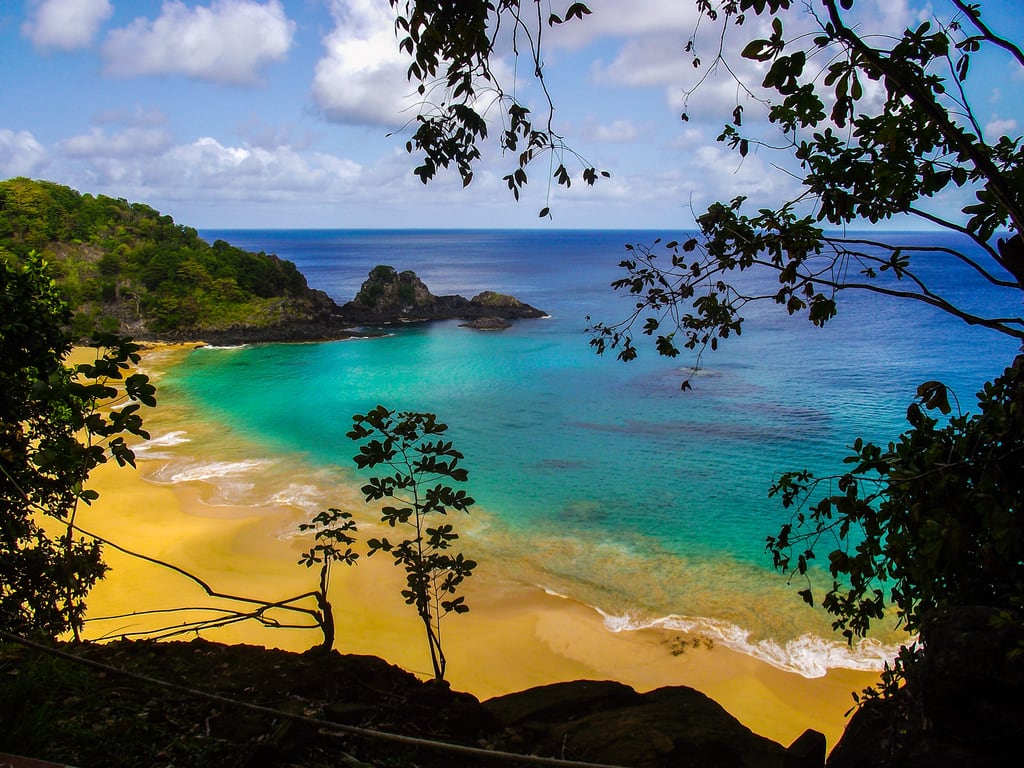
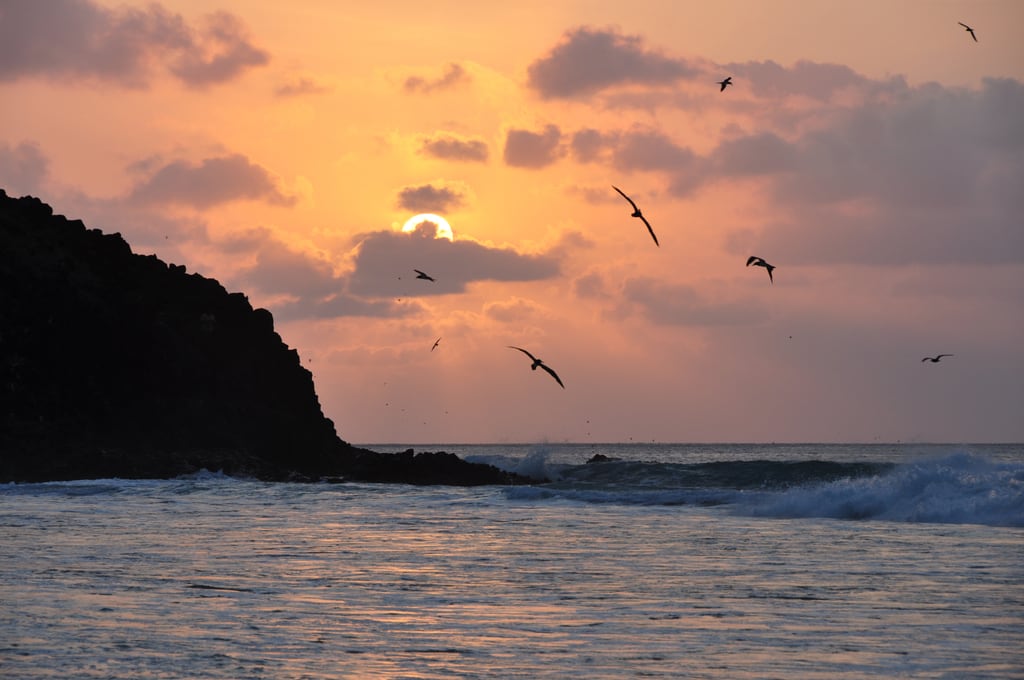
Baía dos Golfinhos is a viewpoint, and only a viewpoint. Descending into the bay, swimming in it and taking boats through it have all been prohibited since 1986. Spinner dolphins use the cove to rest, breed and raise calves, moving offshore in the afternoon to feed — UNESCO’s inscription calls it the only known place in the world with such a large resident dolphin population. Go early; the mirante opens at 06:30.
Praia do Leão, open 08:00 to 18:00, is the archipelago’s principal green turtle nesting beach, with nesting running from December through May. It is also one of the most isolated beaches on the island, and the park warns explicitly about strong currents. Walking on the exposed reef platforms at low tide is forbidden, as is climbing Morro do Leão and Ilha da Viuvinha.
4. The Atalaia Natural Pool
Atalaia is a shallow tidal pool over living reef, and it has the strictest rules of anywhere on the island. Booking is mandatory. Opening times are set daily by the low-tide table, so there is no fixed hour — you fit around the sea, not the other way round.
- No sunscreen or cosmetics may be worn into the water. This is not a suggestion; it is the reason the pool still has anything living in it.
- Life jacket, mask and snorkel are compulsory.
- You may not stand, kneel or push off the bottom at any point. You float, and that is all.
- The trail is about 3 km round trip, roughly 30 minutes each way over dirt and rock, rated medium difficulty.
Five other routes — Capim-Açu, Enseada dos Abreu, Pontinha-Caieira, the combined Atalaia–Pontinha–Caieira and Morro São José — also need advance booking, and four of them require an ICMBio-credentialed guide.
5. Baía dos Porcos, Cacimba do Padre and Morro Dois Irmãos
Baía dos Porcos is a narrow strip of sand hemmed in by sharply cut rock, and on a calm day it is among the best snorkelling on the island. It is reached on foot from the left-hand end of Praia da Cacimba do Padre and needs no advance booking, though access runs to a published timetable and groups can be cut or cancelled depending on how the tide is behaving.
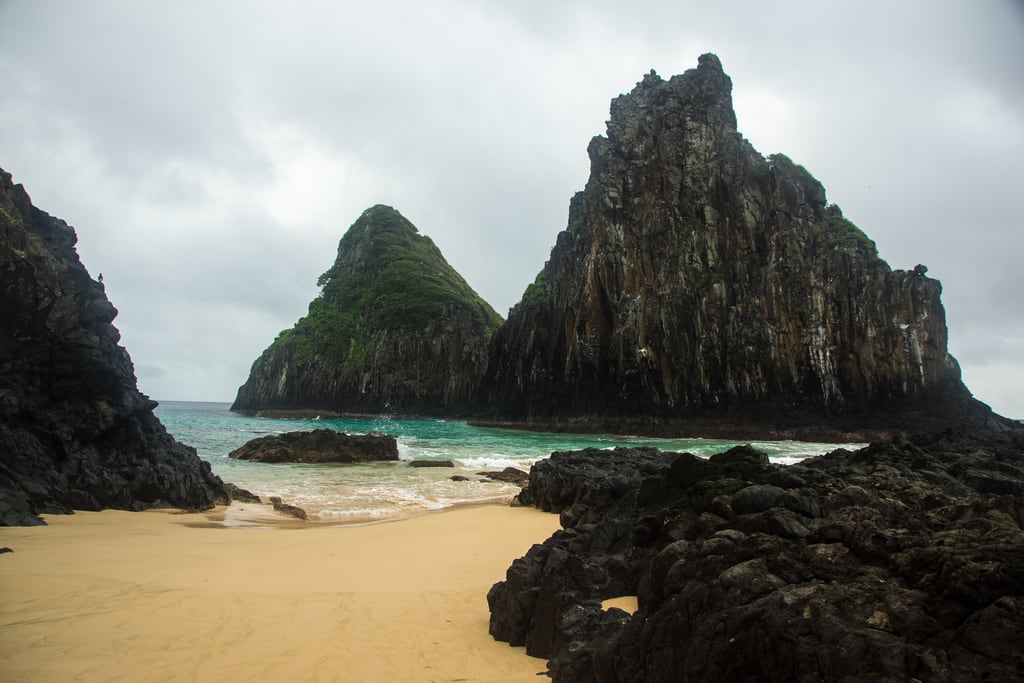
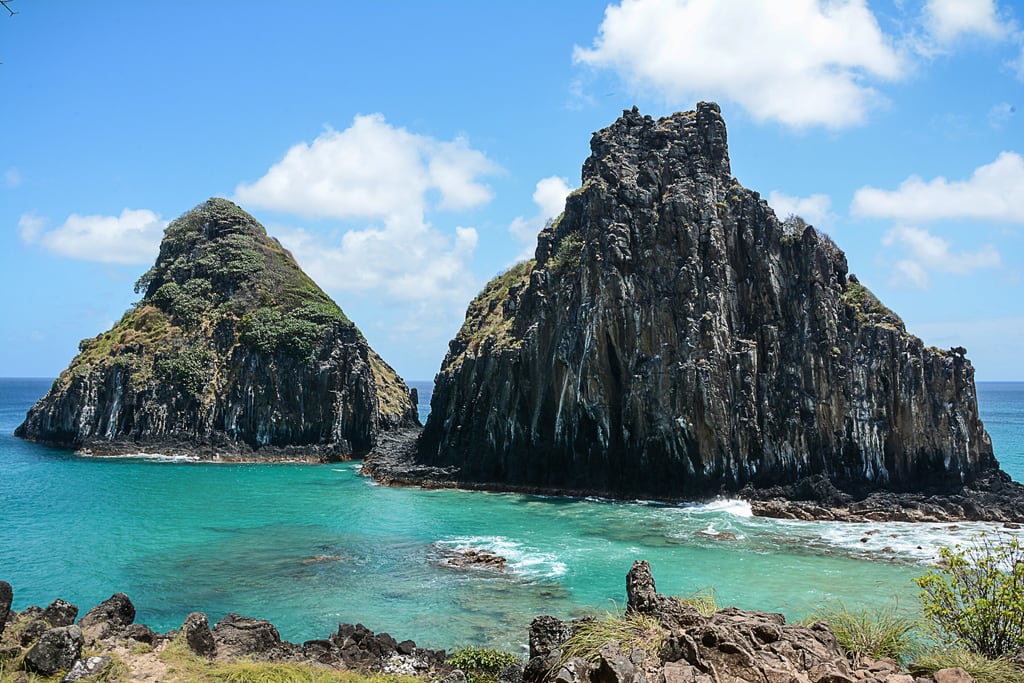
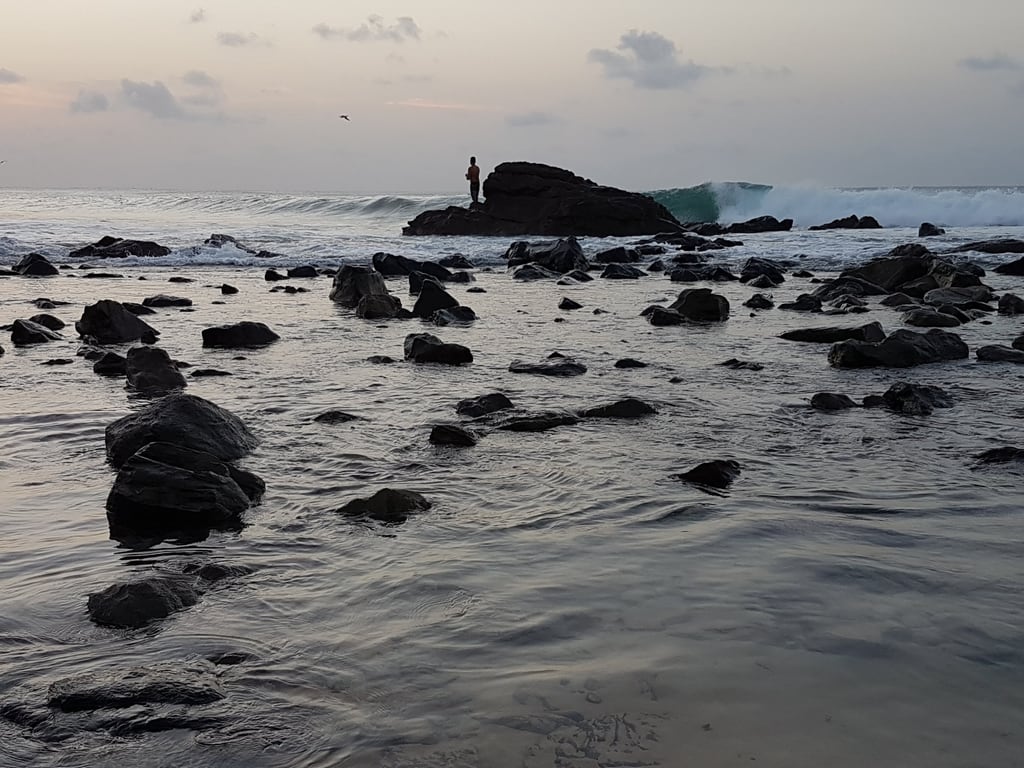
Cacimba do Padre itself is the archipelago’s surf beach, framed by the twin volcanic peaks of Morro Dois Irmãos. From November to April the swell arrives and the break becomes serious — the largest tubular section in Brazil, by local accounts, with February and March the peak months and waves reported up to twelve feet.
6. Diving and the Two Seasons
Noronha’s diving is genuinely world-class: visibility of up to fifty metres, water around 26°C, twenty dive sites and three accredited operators, with dives running from twelve to sixty metres. Discovery dives go to a maximum of twelve metres and are open to people who have never dived, and in some cases to non-swimmers.
The useful thing to know — and it is rarely mentioned — is that the two coasts peak at opposite times. The sheltered mar de dentro dives best from July to December; the exposed mar de fora from March to May. Diving is good year-round, but which side you dive depends on when you come.
| Months | Rain | Best for |
| August – January | Drier | Inner-sea diving, calm snorkelling, the classic beach trip |
| February – July | Wetter, April wettest | Outer-sea diving from March to May; big surf to April |
| November – April | Mixed | Surf season at Cacimba do Padre, peaking February–March |
7. Beyond the Beaches
The Projeto TAMAR visitor centre at Alameda do Boldró is free and open Monday to Saturday, 09:00 to 20:00. TAMAR has worked in the archipelago since 1984 and opened the centre in 1996; it has thematic rooms on sea turtle biology, replicas of all five Brazilian marine turtle species, and a 90-seat auditorium that has run free environmental talks since 1996.
The Forte de Nossa Senhora dos Remédios was built in 1737 by Portuguese troops on the ruins of an earlier Dutch position, later served as a civil prison and held political prisoners under the Estado Novo. It was listed by IPHAN in 1961 and stands 45 metres above the sea, commanding Baía de Santo Antônio with Vila dos Remédios below.
8. Getting There, and How the Island Works
There is one way in: Aeroporto Governador Carlos Wilson (FEN), built in 1934 and rebuilt by the US Army Air Forces in 1942. As of August 2026 the nonstop routes are Recife and São Paulo–Guarulhos, flown between them by Azul, Gol and LATAM; the hop from Recife takes about an hour. There is no scheduled passenger ferry — the only sea arrival is by private vessel, subject to an anchoring fee.
On the island, a single 7-kilometre federal highway, the BR-363, runs from the port at Santo Antônio to Praia do Sueste. It is the only federal highway on a Brazilian oceanic island, which tells you most of what you need to know about the scale of the place.
Beaches you do not need a ticket for
Roughly thirty per cent of the archipelago sits outside the national park, in the sustainable-use APA, and those beaches are free. Praia da Conceição, below Morro do Pico, is the one most visitors default to: an easy stretch with kiosks, reliable for a first afternoon while you get your bearings. Praia do Boldró and Praia da Cacimba do Padre are also in this group. It is worth planning at least one APA day, both to spread the cost and because the park’s tide-dependent sites will not always align with your dates.
One live caveat: snorkelling at Praia do Sueste is currently suspended, leaving the beach open for landscape viewing only. The notice on the park’s site is undated, so confirm before you build a day around it.
9. Accessibility: What Is Real
Noronha publishes more concrete accessibility information than most Brazilian protected areas, and it is candid about limits — the park’s own page states plainly that not all attractions can be adapted. What is documented:
- Over 1,500 metres of raised walkways and accessible decks across the park.
- Accessible toilets at PIC Sancho, PIC Sueste, PIC Leão and the Visitor Centre.
- Praia do Sueste has a fully accessible deck and a beach access ramp.
- The Trilha do Golfinho is built to Brazil’s ABNT accessibility standard.
- Julietti all-terrain trail wheelchairs are available, with seven days' advance booking if monitor support is needed. Recommended routes: Atalaia, Golfinho–Sancho, Forte São Joaquim and Caieiras.
- The Sancho clifftop walkway is wheelchair accessible, though the trail down to the beach is steep and needs a companion.
Accessibility: Two things to check before you commit. The amphibious beach wheelchair service at Sueste is currently flagged as temporarily suspended on the park’s own site, with no restart date — and snorkelling at Sueste is separately suspended, leaving the beach open for viewing only. Both notices are undated, so email the park before travelling if either matters to your trip. We also found no accessibility information at all for the airport, the port, accommodation or ground transport, which is a gap in the published record rather than evidence that nothing exists.
Frequently Asked Questions About Fernando de Noronha
How much does it cost to visit Fernando de Noronha?
Two mandatory charges before anything else: the Pernambuco environmental tax (TPA) at R$105.79 per day of stay in 2026, and the national park ticket at R$192 for Brazilians or R$384 for everyone else, valid ten days. They are separate — paying one does not cover the other.
Is Baía do Sancho still the world’s best beach?
It was named the world’s best in TripAdvisor’s Travelers' Choice awards in 2014, 2015, 2017, 2019 and 2023, but not in 2024, 2025 or 2026, when the top spot went to Portugal, Greece and Mexico. Claims that it has won seven times including 2024 and 2025 are wrong.
How do you get to Fernando de Noronha?
By air only, into Aeroporto Governador Carlos Wilson (FEN). As of August 2026 the nonstop routes are Recife and São Paulo–Guarulhos, flown by Azul, Gol and LATAM. The flight from Recife takes about an hour. There is no scheduled passenger ferry.
When is the best time to visit Fernando de Noronha?
August to January is drier and best for inner-sea diving and calm snorkelling. March to May suits outer-sea diving. Surfers want November to April, peaking in February and March. Rain concentrates between February and July, with April the wettest month.
Is Fernando de Noronha accessible for wheelchair users?
Partly, and better than most Brazilian parks. There are over 1,500 metres of accessible decks and walkways, accessible toilets at four locations, an ABNT-standard trail, an accessible deck and ramp at Sueste, all-terrain trail chairs bookable seven days ahead, and a wheelchair-accessible walkway to the Sancho clifftop viewpoints. The beach at Sancho itself is not accessible — it is reached by a vertical ladder.
Conclusion
Noronha asks more of a visitor than anywhere else in Brazil: two fees, tide-dependent timetables, mandatory guides, banned sunscreen, a ladder you queue for, and a beach where you are not allowed to touch the bottom. All of it exists because the alternative is losing the thing people come to see, and the island has the visitor numbers to prove the pressure is real.
Plan around the rules rather than against them. Book the tide-dependent trails first and build the rest of the trip around them, pay both charges before you fly, and pick your months by which coast you want to be in the water on.
If you would like this organised for you — including access needs, which take real planning here — see our tours or get in touch. Comparing island trips? Our guides to Lençóis Maranhenses and Salvador pair well with Noronha on a northeastern itinerary.
Image credits: Adelano Lázaro, Bruno Lenharo, Cassinha Magalhães, Lgjunior, Elisangela Rocha, Moises Carmo (CC BY-SA 4.0); Rafa Tecchio, NicolasAlbuquerqueWolf (CC BY-SA 3.0), via Wikimedia Commons.
 English
 Portuguese
  Español
  Français
  Deutsch
  Italiano